|
|
 |
Walking
on the Edge of the Serengeti
Report
By Delta Willis
My first walking safari
in Tanzania was eight years ago in the Selous, trekking with Richard Bonham,
the Kenya-born conservationist who founded Ol Donyo Wuas and Sand River Selous.
Walking in Africa has long had an appeal to me, especially in the arid terrain
around Lake Turkana, where I searched for fossils alongside the Leakeys.
This time my guide Mark Houldsworth handily out paced me and loped up hills
as if there were a cold beer waiting at the top. There
was.
We were walking on the
northeastern edge of the Serengeti, just outside the famous national park
known for its vast, endless plains. Accompanied by two
Maasai, there were only six of us total, ideal for seeing wildlife. We saw
a majestic lion with a mouth red from his morning meal, Cape buffalo that
kept us wide of the thicket where they lurked, and exceptional birds. The
lion were enjoying the moveable feast of wildebeest, which had drifted down
from Kenya, only a few miles to the north. As the raptor flies, we were only
a morning�s glide from the Maasai Mara. But as beaten paths go, we were totally
remote from the caravans of mini-vans, and the only other humans we saw on
our trek were Maasai herding their cattle, and our camp staff, so discreet
as to be invisible except when your glass nears empty.
So at midday they appeared
like a vision, standing proudly behind a table laden with a hearty lunch,
beneath a shade tree. They were only a hundred yards away; unfortunately
there was another hill and valley between us.
After lunch, the staff
built a little fire and we snoozed before setting out again. The walks are
very cushioned; we could telephone for tea to be delivered, for example,
but it�s not always possible to depart from the group and return to camp,
because often camp is on the move. For five days, while we were walking,
our camp from the previous night was being disassembled then reassembled
at a
prime spot 10 miles away. How the staff manage to do this,
and organize a sit down lunch in the middle of nowhere �with food as good as
any lodge in East Africa � is remarkable.
 By
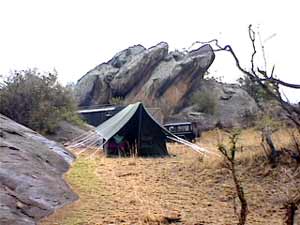
the time we arrived, just before sundown, our comfortable tents would be
totaled prepared, with our luggage in place, our laundry pressed and ready
from the day before, our shower ready, and our own private outdoor canvas
toilet, known as a short drop. These mobile camps are very comfortable, with
thick mattresses on the cots, and rather roomy tents, with a verandah, and
well-placed from your neighbor for privacy. It is certainly a luxury to walk
in Africa and arrive to find your camp totally set up and prepared. One of
our camp sites was among the kopje outcrops that mark the Serengeti, and
so what if I caught a glimpse of a lodge light in the great distance! We
went to sleep within earshot of lions roaring, and in the morning, woke to
birdsong. There was no line of people at breakfast, and best of all, we didn�t
climb into a vehicle, but put one foot in front of the other and headed for
another beautiful horizon. By
the time we arrived, just before sundown, our comfortable tents would be
totaled prepared, with our luggage in place, our laundry pressed and ready
from the day before, our shower ready, and our own private outdoor canvas
toilet, known as a short drop. These mobile camps are very comfortable, with
thick mattresses on the cots, and rather roomy tents, with a verandah, and
well-placed from your neighbor for privacy. It is certainly a luxury to walk
in Africa and arrive to find your camp totally set up and prepared. One of
our camp sites was among the kopje outcrops that mark the Serengeti, and
so what if I caught a glimpse of a lodge light in the great distance! We
went to sleep within earshot of lions roaring, and in the morning, woke to
birdsong. There was no line of people at breakfast, and best of all, we didn�t
climb into a vehicle, but put one foot in front of the other and headed for
another beautiful horizon.
For people who�ve never
been walking in Africa, both Mark Houldsworth
and Roland Purcell note that many people like the idea of a walking safari
more than the real thing. So you should understand that agility is required,
and it can be hot, then quickly cool, which allowed me to road
test some safari clothes.
|
