|
|
 |
Tanzania, Inside Information
 You
can�t get much deeper inside Tanzania than with Roland Purcell, an escaped
auctioneer from Sotheby�s who pitched his first camp closer to the Congo than
the nearest road in Tanzania, and did so with custom tents befitting a Sultan. When
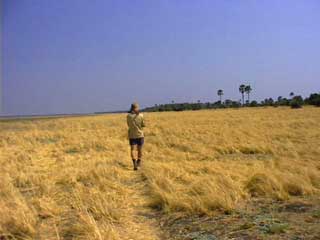
Purcell led me across a vast golden flood plain in a remote park called Katavi, I was
convinced I could perceive the curvature of the earth. As he poured wine on the first night, he declared, �There�s not
another dinner party for a million square miles.� You
can�t get much deeper inside Tanzania than with Roland Purcell, an escaped
auctioneer from Sotheby�s who pitched his first camp closer to the Congo than
the nearest road in Tanzania, and did so with custom tents befitting a Sultan. When
Purcell led me across a vast golden flood plain in a remote park called Katavi, I was
convinced I could perceive the curvature of the earth. As he poured wine on the first night, he declared, �There�s not
another dinner party for a million square miles.�
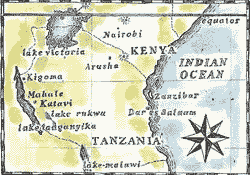 Katavi National Park is far west of the
Selous Reserve, even beyond Ruaha- sacred names to aficionados who eschew
Tanzania�s Northern Circuit (including Ngorongoro Crater;) tamed by
popularity. I will see no minivans in Katavi, no other people, hear no pundits.
The lethal drip of CNN has ceased. At night, silence can be as great as the wide
world, broken by the occasional yip of hyena, the crackle of the campfire, and
stories whispered in an intimate tone, as if we were in a vast theater. Katavi National Park is far west of the
Selous Reserve, even beyond Ruaha- sacred names to aficionados who eschew
Tanzania�s Northern Circuit (including Ngorongoro Crater;) tamed by
popularity. I will see no minivans in Katavi, no other people, hear no pundits.
The lethal drip of CNN has ceased. At night, silence can be as great as the wide
world, broken by the occasional yip of hyena, the crackle of the campfire, and
stories whispered in an intimate tone, as if we were in a vast theater.
Only
in undisturbed pockets such as this can modern travelers recapture what drew
explorers and misfits like me to Africa in the first place. �It�s never to late to have a happy childhood,� notes the Purcells�
Greystoke brochure, and here the herds are wild enough to rekindle primeval
dreams. Beyond hyperbole, you simply can�t walk in most national parks, and
there is nothing in the world like walking in Africa. Australia has its
walkabouts, the landscapes of Europe are equally beautiful to behold, and I can
clear the cobwebs from my eyes in Manhattan�s Riverside Park. But on this
continent where our kind first began to walk upright on two legs, putting one
foot in front of the other can transport you back to these roots. Perhaps this
is the reason many people feel a surprising instant kinship with Africa; as
Karen Blixen wrote in Out of Africa, �Here I am where I ought to be.�
The
landscape we traversed lies on the eastern side of Lake Tanganyika, well south
of the equator but scarcely a hand axe throw east of 30 degrees longitude. A GPS
cannot impart the essential, that here on the edge of the Great Rift Valley you
can sense your position with regard to the Universe. There are visceral
reminders of ancient tensions between predator and prey, and the timeless appeal
of being nomadic. Purcell satisfies this wanderlust with a mobile camp being set
up 8 miles ahead of us.
Human
evolution, clouded by the wooly debates of fossil finders, becomes as clear as
the water in the lake to our west, and just as deep. The visibility of the lake,
it should be said, diminishes as you go deeper.
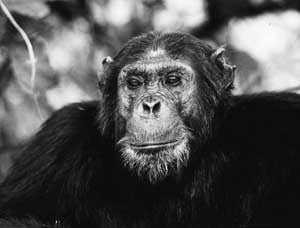 To confirm human kinship with apes, look a chimp in the eye;
Roland Purcell�s Mahale Mountain Camp is the perfect place to do this. DNA evidence suggests
chimps are our closest relatives among the apish primates, and there are also
convincing behavioral clues: males will drum the ground and scream when trying
to establish dominance, and chimps are the only animals apart from us that
recognize and study themselves in a mirror.
To confirm human kinship with apes, look a chimp in the eye;
Roland Purcell�s Mahale Mountain Camp is the perfect place to do this. DNA evidence suggests
chimps are our closest relatives among the apish primates, and there are also
convincing behavioral clues: males will drum the ground and scream when trying
to establish dominance, and chimps are the only animals apart from us that
recognize and study themselves in a mirror.
For
the nitty gritty science and insights of Stephen Jay Gould and Meave Leakey,
check your local library for a copy or order The
Hominid Gang, Behind the Scenes in the Search for Human Origins
Lake
Tanganyika has been sounded to 4,710 feet. Formed over three million years old,
it does not compete with Lake Victoria when seen on a map. Victoria is commonly
described as Africa�s largest lake, and by surface area, it is, covering an
area about the size of the state of Maine. But Lake Victoria is shallow, nowhere
deeper than 300 feet. By volume,
Lake Tanganyika is eight times larger, and it is the world�s longest
freshwater lake, stretching 420 miles north to south. Geysers that warm these waters to 86 degrees originate from a lake bottom
pulled below sea level by the shifting tectonics that created the Great Rift
Valley, a scar that stretches from the Red Sea to Mozambique and is visible from
the moon.
On
the eastern side of the lake, in the forests of the Mahale Mountains, are many
primates, including chimpanzees, red colobus monkeys, and yellow baboon that
dine on some of the 198 species of plants. It is an ecosystem more akin to the
range of mountain gorillas and other primates to the north, in Rwanda, Uganda,
and that evolutionary incubator formerly known as Zaire. The Rift split ancient
ape environments all along the heart of Africa, where you find dense forests,
including the notorious Impenetrable, adjacent to savannahs favored by antelope
and other plains game.
In
such a savannah it seems prudent to hunt on foot. Trees are few and potential
meals are fleet of foot, best killed by strategies honed in predators that do
not take kindly to scavengers. Walking
in the grasses of Katavi, Roland points out three lionesses, their blonde coats
exactly the same hue as the grass. Only the red of their bloody meal makes them
visible. �Let�s move downwind and give them a wide berth,� he whispers;
�There may not be enough to go around.�
I
went to Katavi in early October, during a drought exacerbated by rains too brief
and too late, three seasons in a row. Before this, the endless rains of El Nino
had flooded the area, washing out every second-rate bridge between here and
Nanyuki. Waters rose half way up to the branch level of fish eagles that now
watch over browned catfish, basted in a thin layer of mud, baked by the African
sun. I�m reminded of dinners in China when fish are steamed with a towel
around their head to create a strange sort of moveable feast; these cooked
catfish are relatively fresh since they too still flop.
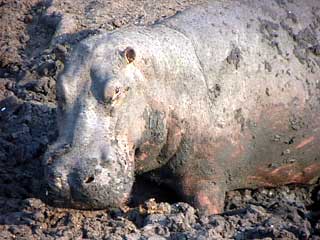 Everything
that once thrived in this former river has come together in the only water that
remains, parched and evaporated down to a few mud holes edged by polygon cracks.
A strange sedimentary formation, dotted with red eyes, turns out to be a pod of
hippo. Packed together and oozing pink, their glands secret a rosy fluid to
protect them from sunburn, deemed �sweating blood,� closer to the truth than
any euphemism deserves to be. Without
rain, in a few weeks the hippo will die, because their bodies are so adapted to
the life that water provides them. Hippo spend up to 18 hours a day submerged,
to keep cool and minimize heat lost. Water
also makes buoyant a body that can weigh up to 7,000 pounds in an adult male,
rivaling the African elephant for weight. Marooned
like this they are weary and therefore vulnerable to predators, including humans
who eat their meat. Everything
that once thrived in this former river has come together in the only water that
remains, parched and evaporated down to a few mud holes edged by polygon cracks.
A strange sedimentary formation, dotted with red eyes, turns out to be a pod of
hippo. Packed together and oozing pink, their glands secret a rosy fluid to
protect them from sunburn, deemed �sweating blood,� closer to the truth than
any euphemism deserves to be. Without
rain, in a few weeks the hippo will die, because their bodies are so adapted to
the life that water provides them. Hippo spend up to 18 hours a day submerged,
to keep cool and minimize heat lost. Water
also makes buoyant a body that can weigh up to 7,000 pounds in an adult male,
rivaling the African elephant for weight. Marooned
like this they are weary and therefore vulnerable to predators, including humans
who eat their meat.
At
another mud hole crocodile lay alongside each other, imitating tree trunks with
interesting bark. One by one
nictitating membranes slide down to permit a glimpse of us, but the fire has
gone from their eyes, glossy with the bleary look of a drunk. Whether warm-blooded or cold, animals can react to stress just as
individually as human personalities do, with unpredictable paths of crankiness
or violence or defeatism. A drought
brings about an edge to behavior, but fortunately for observers like us, safe in
a Land Rover, this kind of pressure also induces a sad and listless fatigue. As
long as we kept our distance, they saved their energy.
On
foot we walked toward the only water to be had under these conditions, a spring
fed by underground rivers. By the time we arrive at our fly camp, a herd of Cape
buffalo dominate the nearby spring, keeping topi and other antelope waiting in a
line that stretched half a mile across the grassy plains. Then a herd of
elephant appeared out of the trees behind our camp. Protectively guarding a
two-week old infant, they slowly paraded within a hundred yards of our
entourage, which included the Purcells 3 year-old son Wolfe. The elephants
lifted  their trunks to smell us, and Zoe Purcell whispered to her son to please
keep very quiet and still so as to not make the elephants fear for their baby. Five
minutes later the elephants had overtaken the water source, mostly by simply
arriving and announcing their size,
although a young bull learning how to be macho seem to make a game out of
chasing other creatures away. Buffalo looked back towards us with their
characteristic expression of dismay, perhaps to see if any more elephants were
arriving from our neck of the woods. Fate might suggest they should thank the
elephant for displacing them. Two buffalo were stuck in the mud near the spring
and their struggles had only lodged them more firmly. �We�ve encountered
this before,� Roland explained; �Unfortunately if you try to save them, the
trauma of tying a rope around their boss and pulling them out by vehicle will
probably kill them, as well as disturb the rest of the animals. And put us in
danger.� With guilt I stared at my glass of fresh cool bottled water, half
full. their trunks to smell us, and Zoe Purcell whispered to her son to please
keep very quiet and still so as to not make the elephants fear for their baby. Five
minutes later the elephants had overtaken the water source, mostly by simply
arriving and announcing their size,
although a young bull learning how to be macho seem to make a game out of
chasing other creatures away. Buffalo looked back towards us with their
characteristic expression of dismay, perhaps to see if any more elephants were
arriving from our neck of the woods. Fate might suggest they should thank the
elephant for displacing them. Two buffalo were stuck in the mud near the spring
and their struggles had only lodged them more firmly. �We�ve encountered
this before,� Roland explained; �Unfortunately if you try to save them, the
trauma of tying a rope around their boss and pulling them out by vehicle will
probably kill them, as well as disturb the rest of the animals. And put us in
danger.� With guilt I stared at my glass of fresh cool bottled water, half
full.
For
the rest of the afternoon we sat enthralled for hours, as if part of a National
Geographic centerfold, witness to a rare Eden that was becoming rarer by the
minute. The interactions of the elephant were enhanced by the presence of
Daniella Blatiler, formerly with Abu Camp in Botswana, and an expert on
elephants. When an Abu Camp staff
worker was killed by one of the �tame� elephants last year, Daniella left to
become camp manager at Katavi.
The
scenes before us unfolded dramatically as if already edited for television.
There was no down time because we were sitting outside, beneath the trees,
within ear shot, and part of this, rather than glimpsing something briefly from
a vehicle then moving on, and because this was Katavi. Heaven and hell meet here
regularly. My heart that had felt heavy from the certain death that looms is
promptly lifted by the sight of dainty zebra, only weeks old, and hundreds of
delicate topi antelope, dancing alongside their mothers. The timing of their
birth is this year a gamble, since they are weaned only when the rains arrive,
which will provide their first taste of green grass. Meanwhile their mothers
continue to nurse them as their own bodies lack for sustenance during the
drought.
The
sky is cloudless, the grass parched yellow, which becomes that classic
Kodachrome gold at sundown. At dusk the hyena begin to arrive, surveying the
herd for the young and weak, the injured, the stuck in the mud. Zoe Purcell
shines a flash light out onto the plains, and the eyes of three hyena shine
back. They promptly disappear as the hyena saunter with their wicked he-hee-hee,
like teenage girls on their way to a verboten party.
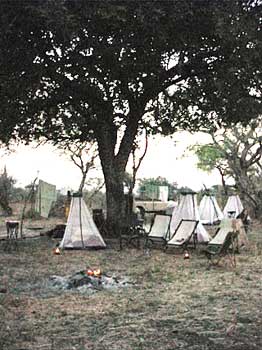 I sleep in a bedroll beneath a
mosquito net propped up by a single pole. A lantern is positioned by each
bedroll, and a campfire burns for much of the night, its mission to discourage
carnivores from finding us more tempting that the feast laid out for them. Well
before dawn, when the stars are still visible in the sky, it takes me what seems
like forever, perhaps 20 minutes, to screw up my courage to emerge from the
superficial safety of the net to stoke the fire. I reckon the chimps at Mahale might be slightly wiser than we Homo
sapiens sapiens. They sleep high in the trees, on a bed of leaves. I sleep in a bedroll beneath a
mosquito net propped up by a single pole. A lantern is positioned by each
bedroll, and a campfire burns for much of the night, its mission to discourage
carnivores from finding us more tempting that the feast laid out for them. Well
before dawn, when the stars are still visible in the sky, it takes me what seems
like forever, perhaps 20 minutes, to screw up my courage to emerge from the
superficial safety of the net to stoke the fire. I reckon the chimps at Mahale might be slightly wiser than we Homo
sapiens sapiens. They sleep high in the trees, on a bed of leaves.
Roland
Purcell tells me he plans to build a tree house in the forest canopy at
Mahale, so that guests can get close to that experience. I�ll take
a tent beneath the borassus palms, thank you, to hear the waters of Lake Tanganyika lap at the shore.
The
cost of chartering a plane to this remote area of Tanzania has been an effective
filter.Previous guests have
included members of the New York Explorer�s Club on a private jet tour of
Africa, Microsoft chairman Bill Gates, and a group of Texans (with slightly
older money) whose leader declared the mission statement in a dinner toast:
�Rape, riot and revolution! May prostitution prosper, and son of a bitch
become a household word!�
�I
ran to my tent to jot it down,� says Purcell, such
a wit in his own write that more than once I felt I was walking with Michael
Palin.
Both
the Mahale and Katavi Camps have only 6 tents, which means 12 visitors maximum.
(You can have a group of 24 and dosey-doe.) Both camps are disassembled during
the rainy seasons, normally between mid-October and mid-December, and again
mid-February to May, and there is an extra charge for fly camps.
For
information about booking the Katavi or Mahale Camps, Contact Delta
|
