|
|
 |
Report from Kenya
I arrived in Africa as one should, to shed my New York boots and wrap a kikoi
around my waist. Only 48 hours ago I'd been walking my cocker spaniel in Riverside
Park, with more snow than I saw on Mt. Kenya on my approach. The snowy summits
of Kenya's tallest peak and Kilimanjaro are diminished by global warming.
During my layover in England I was whisked away to the medieval home of Mike
and Jennifer Shirley-Beavan. The owners of Bushbuck Safaris and impetus behind
the revival of the Catalina plane treated me to an update on their favorite
places in Africa, a hearty lunch, and most important to diminish jet lag, a
bedroom for a good long snooze before beginning the next leg of my journey
to Africa. There are two essential things to do when you fly into Kenya.
1) Request a seat on the port side so that you can see the Rift Valley Lakes
of Turkana, Baringo, and Naivasha on your approach to Nairobi; it's a good
idea to have a map on your knees, but on this, my 29th trip to Africa, I had
no trouble recognizing the Crescent Island that distinguishes Lake Navaisha,
the dark jagged peak of Mt. Kenya, or the Great Rift Valley, a scar in the
earth stretching from the Red Sea to Mozambique, visible from the moon, and
widening a few inches every year. This rift is thought to be what separated
humans from apes, with savannahs on the eastern side requiring adaptations
to a new environment, and western forests harboring our not so distant relatives.
Foraging for foods in the savannah grasslands required new skills, or as Richard
Leakey once put it while cracking open oysters on the half shell: �All adaptations
stem from the gut.�
2) With my feet up, my back relaxing on a reclining seat, my glass filled
with cold champagne, I toast the hunters and gatherers who cater for British
Airways Club World, serving great meals (breakfast with fresh fruits, dinner
with entree choices.)
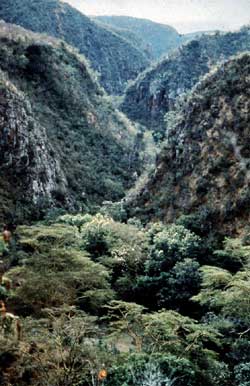 After
I saw the distinctive peak of Mt. Kenya on the horizon, I notice a dramatic
gorge. As best I can figure, that is the famous Mukutan Gorge, not so distant
from Lake Baringo, where another ancient hominid was recently unearthed.
The Leakeys and other paleontologists find so many fossils in this area because
the Great Rift lakes attracted them, and exposed them. Nearly two decades
ago I helped them unearth the bones of the Turkana Boy, so called because
it was a discovered near the great lake that (seen on the map) hangs like
a sock on the Ethiopian border with Kenya. After those two decades things
are still being learned from this young Homo erectus skeleton; Nature does
not impart her secrets easily, whether it�s science, or human nature. After
I saw the distinctive peak of Mt. Kenya on the horizon, I notice a dramatic
gorge. As best I can figure, that is the famous Mukutan Gorge, not so distant
from Lake Baringo, where another ancient hominid was recently unearthed.
The Leakeys and other paleontologists find so many fossils in this area because
the Great Rift lakes attracted them, and exposed them. Nearly two decades
ago I helped them unearth the bones of the Turkana Boy, so called because
it was a discovered near the great lake that (seen on the map) hangs like
a sock on the Ethiopian border with Kenya. After those two decades things
are still being learned from this young Homo erectus skeleton; Nature does
not impart her secrets easily, whether it�s science, or human nature.
Upon my arrival
in Nairobi, I am thrust into a circle that resembles a casting call for Rules
of the Wild,
Francesca Marciano's novel about Nairobi�s narcissistic young expatriates and
third-generation white Africans. Esme, the beautiful twenty-something Italian
narrator, goes on safari, seeking to escape a painful past, and like most visitors,
becomes captivated by the beauty of the landscape and her new "tribe." She
is promptly torn between two dynamic lovers--one a safari guide, the other
a cynical journalist obsessed by the carnage of Somalia and Rwanda. Now Aidan
Hartley has come out with his own book The
Zanzibar Chest: A Story of Life, Love, and Death in Foreign Lands a
memoir describing his experiences as a Reuters stringer covering Somalia and
Rwanda. Written with
a journalist�s eye, the book becomes passionate when
Hartley describes the brutal deaths of Reuters colleagues stoned to death by
an angry mob in Mogadishu, enough to send anyone into a mad spin. A love affair
during Rwandan genocide, his own abuse of drugs and alcohol, gain little perspective
by the author�s attempt to tell the story of Peter Davey, whose diary Hartley
discovers in the wooden Zanzibar Chest of the title. The allure of the African
continent, despite deadly rifts, the hellish abyss, is better expressed by
the novelist from Italy: "I'll tell you what it is about this place....
you are constantly reminded of what it means to be free and to be alive. And
then it becomes difficult to settle for anything less than this."
|
