|

To explore Africa from above, perched between the wings of a small plane, is to cast a shadow with as many layers as a life of contradiction. In 1936, a tall, Madonna template named Beryl Markham had the nerve to take her shadow out of Africa and cross the Atlantic. Pitting a Percival Vega Gull against stormy skies, she wrapped her life around a single engine and gas tanks without gauges. She flew at night, against the wind, setting a course to do Lindbergh in reverse. Without radar, without radio contact, Markham relinquished familiar landmarks –the hills and folds of the Great Rift Valley, the brown rivers of Kenya and Tanganyika, the tracks of the Lunatic Express - for a dark, grey void.
For the better part of two days and nights, she was denied Africa’s treeless stretches in case her engine coughed. It happened twice, and twice she threw instinct over as ballast.
Waters was rushing towards her. Pull up, the brain waved, Pull up. But years of experience as a pilot told her the 2,000 feet between her and the Atlantic was all in the world she had, and to use it as a tool. Her only hope was in “a contrary act,” pointing her stalled plane towards the water, “a terrifying abandonment, not only of reason, but of sanity. Your mind and your heart reject it. It is your hands –your stranger’s hands –that follow with unfeeling precision the letter of the law.” She switched tanks; and her gull found lift.
Unlike Amelia Earhart, Beryl Markham found land. She buried her nose in it. When rescued by local fishermen in Nova Scotia, she was only one hundred and fifty yards from the shore. 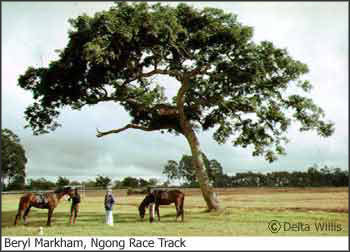
West With the Night describes her solo flight across the Atlantic and her adventures as a girl in British East Africa. I met her when the only thing girlish about either of us was a love for horses. She worked as a trainer at the Ngong Race Track and lived in a modest bungalow nearby. At dawn her horses were brought to her bedroom window to wake her. It was on one of those mornings that I snapped the photo which ran in the Village Voice a few months later, with Stanley Crouch’s review of West With the Night. |

